FROM RAPA NUI TO PERU
RAPA NUI (EASTER ISLAND): Polynesians settled Easter Island around 600 A.D. They developed a sophisticated culture and prospered. Around 800 A.D. they started carving Moai (statues). Each extended family (tribe) went to a communal quarry and carved ever larger Moai. The largest, which was never finished, was 21 meters tall and weighed 270 tons.
Once carved the Moai were somehow transported to a tribe’s area and erected on platforms over grave sites. It is believed that this was form of ancestor worship, and that the Moai were used to placate the gods, who would then give Mana (power) to the tribe. At the peak 12,000 inhabitants lived on Easter Island.
However, the culture had a collapse about 50 years before the arrival of the first Europeans. Work on Moai ceased and the tribes descended into warfare and eventually cannibalism. The Moai were knocked over. One theory of the cause of the collapse is the depletion of natural resources. For example, the island had become completely deforested. There is probably a lesson for us in this overuse of resources.
The arrival of Europeans only made matters worse as they brought not only Christianity, but disease and slave raiders.
A visit to Easter Island was to be a highlight of this cruise for most passengers. However, entrance to the small harbour is very narrow and just wide enough for the tender boats. When we arrived, huge breakers were crashing at this entrance and the Harbour Master closed the port. We waited for several hours before giving up. Our captain, however, slowly circled the island so we could see the Moai, at least at a distance.


DAYS AT SEA: It is a four-day sail from Easter Island to Peru. We encountered high winds and moderately rough seas. We spent our time not only eating and drinking and attending the live shows but going to cooking demonstrations (mostly Betty did this), going to movies (my favorite was the academy award winning Green Book), and attending various lectures.
One particularly interesting lecture was by Dr. David Spence, Director of Stroke Prevention at the Robarts Research Institute of The University of Western Ontario. Dr. Roberts’ lecture covered some familiar ground (don’t smoke, exercise regularly, eat a Mediterranean diet) but also some surprises. He was critical of the medical profession noting that there are three distinct types of hypertension and many doctors prescribe the wrong medications. He was most critical of American doctors who do unnecessary surgery for asymptomatic carotid stenosis.
He spent a serious amount of time reviewing research on egg yolks and strokes, arguing vehemently that egg yolks are bad and that the research saying they are not is seriously flawed. He claimed that eating one egg yolk is as bad as eating three quarter-pound hamburgers.
CREW ON BOARD: We are on a back-to-back cruise, the first part from Tahiti to Peru and the next continuing on to New York. There are only 870 passengers on the first segment but still 800 crew. While interacting with other passengers is fun, interacting with crew members is just as interesting. We learned that there are 15 who work in the laundry, 3 who tend the ship’s incinerator, and 2 full-time upholsterers.
One young sommelier we met is a single mother (one-year old daughter). The father is not in the picture and the little girl lives with her grandparents. The sommelier supports her, and perhaps the grandparents by working on the ship. She interacts with her daughter each night on Skype.
A perhaps nicer story came from talking to a young waiter from Serbia. He told us that in his village a worker’s wage is 350 Euros per month. He earns 10 times that and in addition his wife is also a crew member. He told us that when they go back home they are considered to be wealthy.
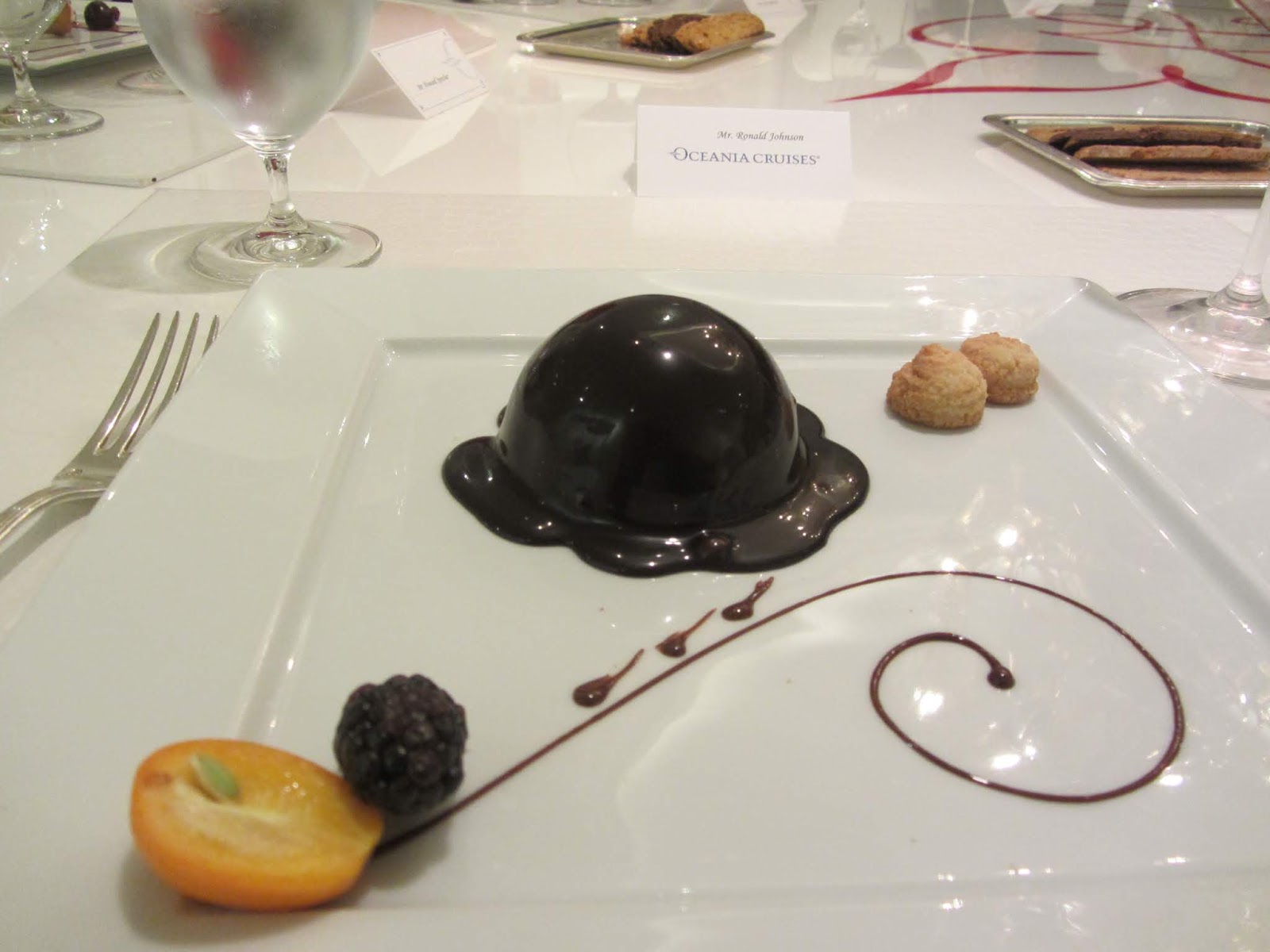
LA RESERVE: There are 7 restaurants on board, none that require supplement payments but four that require reservations. There is an 8th restaurant that is only open some evenings and only seats 24. On our last cruise we used some onboard credits to try a meal. It was so good that we did it again this trip. Different meals are served on different nights but there is no choice of what you eat. Each meal is 8 courses, each course carefully matched with a superb wine (this doesn’t include the Champagne served on deck before being seated.)

We sat at a table for five, along with Francois, originally from Paris, his wife Karen, from South Carolina and their 21 year-old son. Francois was a Chef in Paris before moving to the U.S. Before retiring he owned three restaurants in New York City and a cooking school in South Carolina. We also had lunch with them the next day.

We sat at a table for five, along with Francois, originally from Paris, his wife Karen, from South Carolina and their 21 year-old son. Francois was a Chef in Paris before moving to the U.S. Before retiring he owned three restaurants in New York City and a cooking school in South Carolina. We also had lunch with them the next day.

I enjoyed discussing food and wine with Francois who was very positive about the food on our ship. He claimed that the bread (particularly the croissants) was better than anything in France. I can’t vouch for that but do know it is better than what’s available in Antigonish.

FINAL THOUGHT: “Having a meal without wine is like having sex without a partner.”